Author Archives: Andrea

October 1 2000

Mathematics

Just in case anyone is interested: I finally managed to calculate that damn icosahedron equation today. kugel:

Lemme see… since when have I been working on that one?!?

Back home

Martin has returned from the Allgäu. He promises more photos to come soon!

Und zwei weitere Kapitel von Das rote Band gibt’s auch. facehappy:

Finally

Susan has finally finished both the book and the “Seedy Rom”! Now it’s time to party…

Congratulations, Susan!

What’s your name?

On Über.nu: Names for a New Millenium, by Adam Mathes.

“Last names are so middle ages.” I think I need my own domain… or will I just be Andrea EditThisPageDotCom?!

I thought about renaming my weblog. “Andrea’s Weblog” is just so boring… but so far I haven’t come up with even a single good idea.

Weblog stuff

Dave has a link to You say you want a revolution…, an article about the weblog revolution. Which in turn pointed to Fear of links, a Salon article by Scott Rosenberg.

September 30 2000

Late flip

The day is almost over, at least here in Germany, and I didn’t think I would get to flip the page today, but then I saw Garret’s link. Reading the article got me philosophizing on nature, math, the universe and everything.

The language of nature

Garret linked to this article in the Guardian: The last word on Mathematics.

“[T]he mathematical picture of nature, in the form of an insistent group of equations describing atoms and stars, makes possible such things as electric light, the exploration of space, and the destruction of Hiroshima. This powerfully suggests that mathematics captures truths about the world, and that we would all do well to understand it better therefore.”

The article reminded me of the essay I wrote half a year ago. It was about why mathematics is part of education. (And it reminded me that I have never really gotten around to translating it to English…) One of the points that were important to me is also mentioned in the article:

“The amazing fact is that the physical universe, for all its great diversity, can be described with precision and power in terms of a small number of equations. Galileo himself called mathematics “the language of nature,” and Sir Arthur Eddington remarked that a study of physics gives us a “knowledge of mathematical structures”. Does this mean that reality is fundamentally mathematical? Is mathematics, indeed, reality?”

There are two interesting questions, I think:

  1. Is mathematics something that is invented or discovered?
  2. What came first – nature or mathematics?

From the second question you can see that I believe mathematics to be part of nature and therefore to be discovered, not invented.

In some cases, a certain branch of math has been developed to help describe a phenomenon discovered by physicists because they needed a mathematical tool for it in order to describe and understand it better.

But often enough, it is the other way round. Some mathematicians play around with a theory, discover new ways of solving problems – and a few years later, physicists discover something new and find it can be described by the mathematical means that had been “invented” just for fun!

This doesn’t mean, of course, that everything in the world can be put into formulas and equations, but mathematics sure help you to understand many things and lets you see analogies that would be invisble otherwise.

September 29 2000

Hey!

I don’t believe it. Oliver is back! facehappy:

Grüße nach Bayern!

More solar coronal loops

Susan points to this Time photo essay: Good Day Sunshine. Stunning photos!

I love the web

Last night I finally had time to check out the Cornell University Library Math Book Collection that Craig found for me. They have lots of interesting books, and just for fun I looked for that book that I had trouble finding a week or two ago. And they have it! They really have it! Now, if I want to look something up, I don’t have to go to the library, I can just look it up on the net!

Of course, all the pages are pictures, not real text, so I can’t search them, but I wrote down the page numbers along with the equations. I don’t even know why I did this, but it sure is useful now!

If you want to see proof that the book is really the one, look at these pages from Felix Klein’s “Vorlesungen über die Theorie der elliptischen Modulfunktionen” and compare it to the pages you can see on this photo.

By the way, they also have an English translation of the other book on the photo, Lectures on the Ikosahedron, and virtually any other book by Felix Klein.

Thanks again for pointing out this great source to me, Craig! I guess I’ll have to mention you in the credits section of my thesis… facehappy:

September 28 2000

On the bus

Tonight, I rode the bus home from the University. On the opposite side of the aisle sat a mother with her six-year-old daughter, who – judging by her brand new satchel – was in first grade. The mother looked a bit tired, and she just sat there and looked out of the window while the daughter was browsing through her satchel. She came up with a Pokémon comic book and begged her mom to read it for her. Judging by their accent, they were Americans.

Daughter:“Mom, read it to me!”
Mother:“No. I don’t want to read on the bus. I get a headache.”
Daughter:“Aw, Mom, read it!”
Mother:“No. It’s all in German anyway.”
Daughter:“Mom, read it!”
Mother:“Just look at the pictures.”

The daughter looked at the pictures for a while, than handed it to her mother and asked what was going on in the story.

Mother:    
 
“There’s this blue thing, and then there’s a purple thing, and there’s some stuff happening.”

She hands it back to her daughter, who continues to look at the picture in the book.

Next to them sat an older lady, at least 80 years old. She asked someone if they could please close the little window in the bus because she was cold. The mother closed the other window so the poor woman didn’t have to freeze any more. The daughter however, who was wearing just a t-shirt, was not freezing.

Daughter:“Mom, open the window!”
Mother:“No.”
Daugher:“Mom, open it!”
Mother:“No.”
Daughter:“Why not?”
Mother:“Because Germans’d rather stink.”

At this point, I could hardly keep a straight face.

Daughter:“Open it!”
Mother:“No.”
Daughter:“Open it!”
Mother:“No, they’d rather stink than have fresh air.”
Daugter:“Open it!!”
Mother:“They’d rather stink.”
Daughter:“Open the window, you butt!!”

The mother opened the window.

The man sitting opposite me raised his eyebrows and grinned, shaking his head, and I grinned back.

When mother and daughter got off at the next stop, the man said to me: “I bet she had a hard day!”

star:

English system conversions

Susan shares these cool measurement units with us: bananosecond, lite year, hoarsepower…

BookNotes

Craig has lots of interesting and usefull stuff, as always. How come I totally missed his flipping yesterday? I just went there and found two new days. Hmmm…

Thanks for the link to the Cornell University Library Math Book Collection:

“The Cornell University Math Collection consists of 571 books that were scanned from originals held by the Cornell University Library. All books disbound and all pages scanned.”

I’ll check it out!

And I love Sherlock Holmes. Must have a look at Sherlock Holmes on the web tonight, when I have more time…

Beautiful sun

Look at today’s Astronomy Picture of the Day! It features the solar coronal loops from the CNN article from yesterday.

And once more, I have to thank Daniel for pointing it out to me. By the way, he’s a expert in this field; he’s working on his PhD in Astronomy at the Max-Planch-Institut in Heidelberg.

Hits

Whoa, I got more hits yesterday than array?!

Und angeblich doppelt so viele wie der Schockwellenreiter. grins:

Geht das alles mit rechten Dingen zu?
September 27 2000

Lots of work

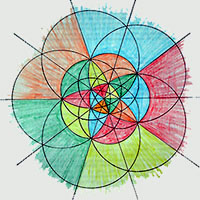
Hmmm… I haven’t been updating my weblog very often today. Instead, I worked on my thesis. And here is the proof that mathematics can be fun and aesthetical too! The picture shows a projection of an icosahedron onto a plane. All faces of the icosahedron are divided into six triangles, and to make them visible, I have painted each face in one color.

The not so nice part of the icosahedron is the ‘icosahedron equation’, and that’s what I’ve been working on today instead of weblogging…

(Yes, I know it’s not a very nice picture; I took a photo of the sheet of paper on which I did the drawing.)
Ikosaederprojektion:

Fountains of fire on the sun

Garret points to this article on CNN. It has impressive photos of solar coronal loops. These loops can be as high as 300,000 miles!

More info about solar activity can be found at the Solar and Heliospheric Observatory (SOHO), a collaboration between NASA and ESA. They have a picture gallery as well as lots of information.

Thanks to Daniel for the link!

And by the way, Daniel has some nice sailing photos, too.

Boom!

Just as I type this, a thunderstorm is hitting Bonn. The weather has changed dramatically since yesterday. While it was all sunny and quite warm yesterday, today it’s overcast and rainy, so I took the train and bus to and from the University. Outside, it’s almost twilight although it’s only 1 p.m.. And now we have this nice thunderstorm with lots of rain. I’m glad I’m home and don’t have to go out again today.

Weather update: The sun came out at around 5 p.m., and just now we’re having a beautiful sunset. And I didn’t realize in time, so I can’t get a photo of it for you. You can’t really see the sun set from our house, I would have to ride out on the ‘Messdorfer Feld’ for the photo, and if I went now, the sun would be down by the time I arrive there…